
Community bank marketers are spending more on digital marketing. But are they connecting the dots between social media performance and the business objectives that matter most?
Bank marketers are, as we all well know, under tremendous pressure to show that their social media marketing campaigns are accomplishing more than generating likes, clicks, followers, and impressions. They're expected to help grow deposits, attract new customers, increase loan activity and strengthen existing relationships; in other words, grow product and service offerings that generate revenue.
According to the recently released American Bankers Association's (ABA) 2026 Bank Marketing Budget Survey, marketing investments are growing across much of the banking industry. Of the 121 institutions surveyed, seven of eight asset categories reported higher median marketing budgets compared with 2025. As pretty much expected, banks are putting the majority of their marketing dollars toward growth objectives: deposit growth (30%), new customer acquisition (23%), and loan growth (20%).
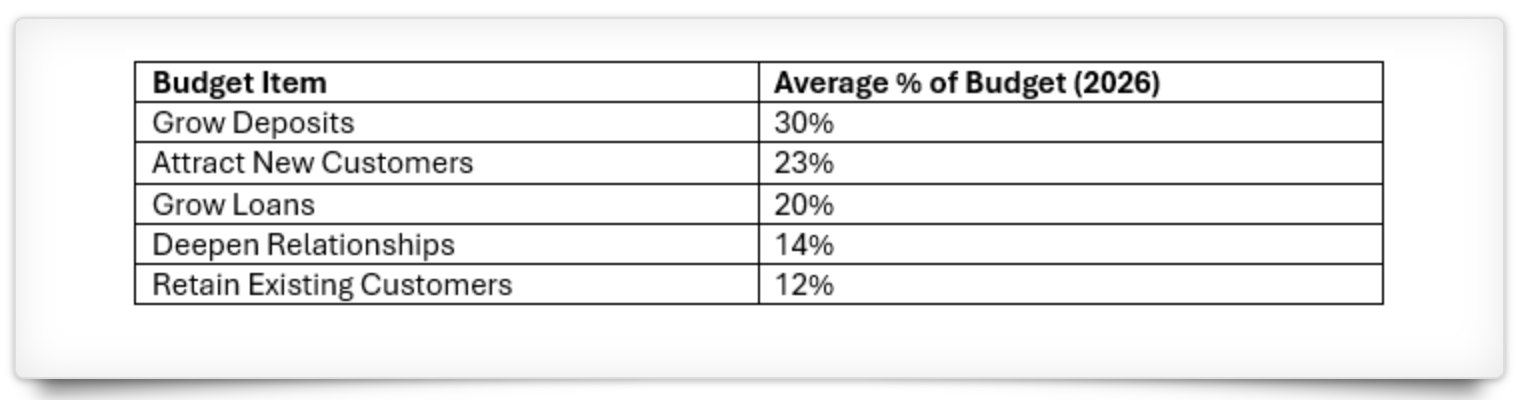
Chart courtesy of American Banker
Digital marketing is getting plenty of attention as well. Digital advertising earned the highest perceived return rating among marketing channels (3.78 out of 5), followed by search engine marketing/optimization (3.62), email (3.40) and social media (3.37). And the investment isn't slowing down. Eighty-five percent of respondents anticipate increasing digital advertising spending in 2027, while 45% expect to increase social media investment.
Clearly, community banks see the value of digital marketing. But here's a question worth considering: Are they getting the information they need to know whether those investments are actually helping the bank achieve its business goals and with that, generate revenue?
The problem with measuring what's easy to measure
Social media platforms, such as Bank Marketing Center’s Social+, offer bank marketers access to an abundance of performance data. Impressions, reach, engagement, shares, comments, clicks, and follower growth are all readily available. That's useful information, of course. But while these numbers tell you how a campaign performed, they don't necessarily tell you whether it accomplished anything meaningful for the bank.
Consider a Facebook campaign promoting home equity loans. It generates 25,000 impressions and 500 engagements. Not bad. The content clearly attracted attention. But did it generate qualified inquiries? Did it encourage customers to contact a loan officer? Did it contribute to new loan applications? Without making those connections, it's easy to confuse activity with achievement.
An April 2026 ABA Banking Journal article, "Using Data to Prove Marketing Effectiveness," highlights this very challenge. The research found that bank marketers place considerably more value on business outcome measurements, including product usage, sales activity, and customer profitability, than on traditional marketing metrics such as impressions, reach, and cost per lead. Makes sense, right? Yet nearly three-quarters (73.4%) of respondents rated their organization's ability to link data to sales and marketing results as neutral to very dissatisfied.
That's a pretty significant disconnect. The takeaway? Bank marketers understand what they need to measure, but many don't have the tools, processes, or data integration necessary to connect marketing activity with actual business performance.
Connecting KPIs to objectives
So how do you turn social media performance indicators into meaningful business measurements and, ultimately, demonstrate a return on investment? Start by working backward. Instead of looking at a social media metric and trying to figure out what it means for the bank, begin with the business objective. Then identify the KPIs that can help you measure progress toward that goal.
Here are a couple of common community bank marketing objectives and the measurements that can help connect the dots:
Growing deposits: If your goal is to attract new deposit relationships, look at KPIs such as clicks to deposit product pages, referral traffic to account-opening pages, inquiries generated and completed applications. Reach and engagement can help you determine whether a campaign is building awareness. Website analytics and account-opening data can help show whether that awareness is leading to action.
Generating loan opportunities: If you're looking to increase mortgage, auto or business loan activity, track clicks to loan information, visits to application pages, and requests for additional information. Just as important, work with your lending team to establish a process for tracking which inquiries turn into appointments, applications and, ultimately, funded loans.
Here's the important distinction: Social media KPIs are indicators of progress, not necessarily proof of financial results. Connecting those metrics to account activity, CRM records, banker follow-up, and sales data gives you a much clearer picture of marketing's contribution.
Turning social media data into insights
Having the right tools certainly helps. Bank Marketing Center's Social+ platform helps community banks move beyond simply publishing social media content and counting engagement. It gives marketers a centralized, easy-to-use resource for monitoring social media performance, tracking reach and follower growth, evaluating engagement, and identifying audience interactions that matter to the marketing team. It’s equally important to keep an eye on comments, questions, and audience responses; these can reveal customer interests and concerns that might otherwise go unnoticed. Those observations can help shape future campaigns, content topics, and customer outreach strategies.
Better questions, better messaging
The ABA's research reinforces an important point: Community banks are investing in digital marketing because it is a proven tactic for delivering meaningful returns. The goal here isn't to collect more marketing data but, instead, to make better decisions with the information already available. Marketers should ask: Are we reaching the right audiences? Which messages generate meaningful engagement? What content encourages customers to take the next step? These are the questions that move marketing from a cost center to a revenue generator.
Bank Marketing Center
At Bank Marketing Center, we provide a subscription-based, automated marketing platform designed specifically to meet the needs of community banks. More than 300 financial institutions currently rely on our platform to help their marketing teams create and deliver relevant, engaging communications that build trust, strengthen customer relationships and contribute to business growth.
We're also committed to sharing what we learn about marketing and the banking industry. From exploring emerging AI technologies and strategies for attracting and retaining employees to discussing operational efficiency and the trends shaping the future of banking, our goal is to offer practical insights that help community banks navigate a changing marketplace and continue to thrive.
Want to learn more about how we can support your community bank and its marketing efforts? Visit bankmarketingcenter.com to see what we can do for you.You're also welcome to contact me directly at 678-528-6688 or email me at nreynolds@bankmarketingcenter.com. As always, I look forward to hearing your thoughts.