The financial services industry is at yet another inflection point. As a recent article on aba.com states: “The financial services industry is undergoing a transformation as banks, insurers, and lenders explore new ways to assess creditworthiness, acquire customers, and retain existing ones.”1
Traditional methods of understanding consumer behaviors, such as credit bureau data and third-party cookies, are no longer sufficient. As a result, forward-thinking financial services providers are increasingly turning to alternative data sources to better understand consumers, enhance their risk management function, and engage customers more effectively.
These alternative, consumer privacy-preserving data sources are powered by Privacy-Enhancing Technologies (PETs). It is these PET-powered platforms that enable parties to extract consumer data and insights without revealing PII (Personally Identifiable Information) or running afoul of consumer privacy protections.
One of the most promising: Grocery data.
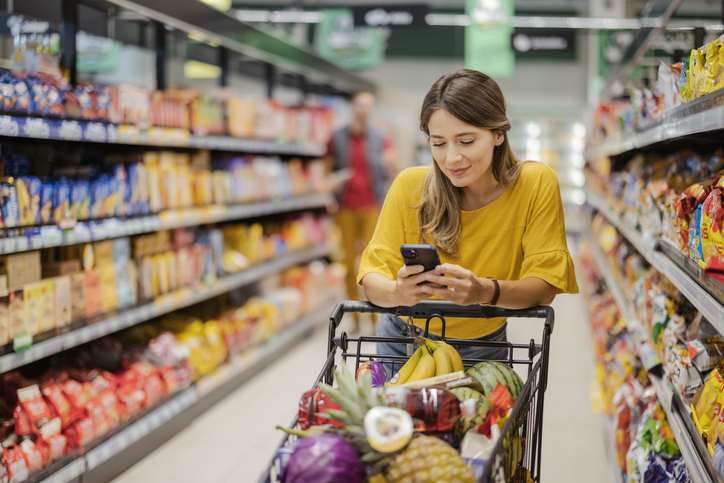
Among the most promising of these sources is grocery shopping data, which offers timely, behavior-based insights while preserving individual privacy. One such provider is Omnisient, a Gold Member of the American Bankers Association Partner Network that “uses PETs and advanced cryptography and AI to enable businesses to discover, validate and commercialize new alternative sources of consumer behavioral data without ever having to exchange data or share consumers’ personal information.”
Why the need?
For decades, credit scores and bureau reports have been the backbone of a bank’s risk assessment. However, 1.4 billion adults around the globe have no access to formal financial services because they lack a credit history, which is only acquired once someone has been granted credit. An estimated 28 million adult Americans are “credit invisible,” with another 21 million considered unscorable due to thin or outdated credit files.2
In addition, new immigrants, younger consumers, gig workers, and cash-centric households are often excluded from traditional financial services not because they are high risk, but because they lack sufficient historical credit data.
Why grocery? Everyone shops.
Alternative data helps bridge this gap by providing a more holistic and real-time insight into a consumer’s behavior. Grocery data, in particular, stands out because it is universal, frequently updated, and highly granular. Nearly every household purchases groceries, making the dataset broadly representative across income levels and demographics. Importantly, research from leading academic institutions has shown that shopping habits can be predictive of financial responsibility.
“Research at Rice University, the University of Notre Dame, and Northwestern University found that variables such as shopping frequency, consistency in spending, choice of products, and use of discount programs correlate strongly with credit risk profiles. Importantly, it demonstrated that these behavioral patterns could significantly improve the predictive power of credit models, particularly for consumers without formal credit histories.”2
Making assessing risk less risky.
From a risk perspective, banks can use grocery data to expand an individual’s access to credit without increasing its exposure to default. In one large-scale case study, a major grocery retailer partnered with a bank to analyze shopping patterns for millions of consumers who were previously unscorable. By leveraging privacy law-compliant data collaboration technology, the bank was able to assess creditworthiness without accessing raw personal data. The result was that millions of consumers became newly eligible for credit, with the bank projecting a significant increase in credit revenue by targeting this underserved segment. Importantly, this approach enhances (not replaces) traditional credit models, improving accuracy while supporting fairer outcomes.2
Enhanced insight-driven marketing.
Beyond credit risk, alternative data is an important tool for bank marketers, especially as the industry moves into a cookie-less world. Financial institutions still, of course, need high-quality, privacy-compliant data to reach the right consumers at the right time with the right message. Grocery data enables marketers to understand lifestyle indicators such as the makeup of the household, the frequency of shopping trips, preferences when it comes to products purchased, (a focus on healthy eating, perhaps?) and brand loyalty; insights that are far more valuable and actionable than tracking website visits.
Doing more with less.
For community bank marketers, this shift is particularly significant. Unlike national banks, community banks thrive on relevance, trust, and personalization of services. They also thrive on smaller marketing budgets and limited marketing resources. Alternative data offers smaller banks an opportunity to better focus their limited resources on high-potential audiences and thus, fight for market share more effectively. For example, families purchasing baby products may be receptive to education savings accounts, health-conscious shoppers could be ideal candidates for wellness-linked rewards programs, and consistent spenders may be strong prospects for credit cards or personal loans. Additionally, the purchase of school lunches or snacks might translate into banking services products such as student checking accounts, while consumers spending on gourmet or specialty items could correlate with rewards credit cards that offer high cashback or travel benefits.
Alternative data also plays a powerful role in customer retention and relationship growth. Grocery data can help banks identify life events and behavioral shifts, such as changes in household size or spending patterns, that signal a shift in financial needs. It can also serve as an early warning system for financial stress, allowing community bankers to offer their support, along with tailored products, before a customer falls into a challenging financial situation. The result? Stronger relationships with customers and reinforcement of a bank’s images as a trusted financial partner.
Compliance is key.
Of course, the use of alternative data must be grounded in ethics and transparency. High-profile missteps in consumer data usage across industries have highlighted the reputational and legal risks of improper practices. For example, back In July of 2022, the CFPB ordered U.S. Bank to pay a $37.5 million penalty after finding that the bank’s employees accessed customers’ credit reports and personal information without authorization in order to open deposit accounts, credit cards, and lines of credit on behalf of customers who had not requested them.
Reduced risk, more focused marketing, greater growth.
Ultimately, the growing use of alternative data in gathering consumer insights reflects the ongoing shift from static assessments to a dynamic, behavior-based understanding. For banks, this means better risk management and growth. For community bank marketers, it unlocks smarter targeting, more relevant messaging, and deeper customer relationships. By leveraging alternative data like grocery shopping insights, community banks can build their brand, strengthen relationships with consumers, compete more effectively, and deliver financial solutions that better align with the lives of the people they serve.
Bank Marketing Center
We’re Bank Marketing Center, the leading subscription-based, automated marketing platform designed especially for community banks. We are presently helping the marketers at over 300 financial institutions craft and distribute topical, compelling marketing communication that builds trust in their brand, deepen customer relationships, and grow revenue.
We do this by automating the essential marketing functions banks rely upon; content creation, social media scheduling and monitoring, digital asset management, compliance routing, and more.
We also believe in sharing what we know and learn. Whether it’s insights on the latest AI tools, tips for attracting and retaining top talent, a webinar on operational efficiency, or what experts are saying about the future of banking, we’re committed to helping community banks thrive.
Want to learn more about what we do for bank marketers to help them succeed? You can start by visiting bankmarketingcenter.com. Then, feel free to contact me directly by phone at 678-528-6688 or via email at nreynolds@bankmarketingcenter.com. As always, I welcome your thoughts.
1aba.com. “Unlocking financial services innovation with grocery data.“ December 10, 2025.
2World Economic Forum. “How grocery shopping data is unlocking financial inclusion.” March 27, 2025.