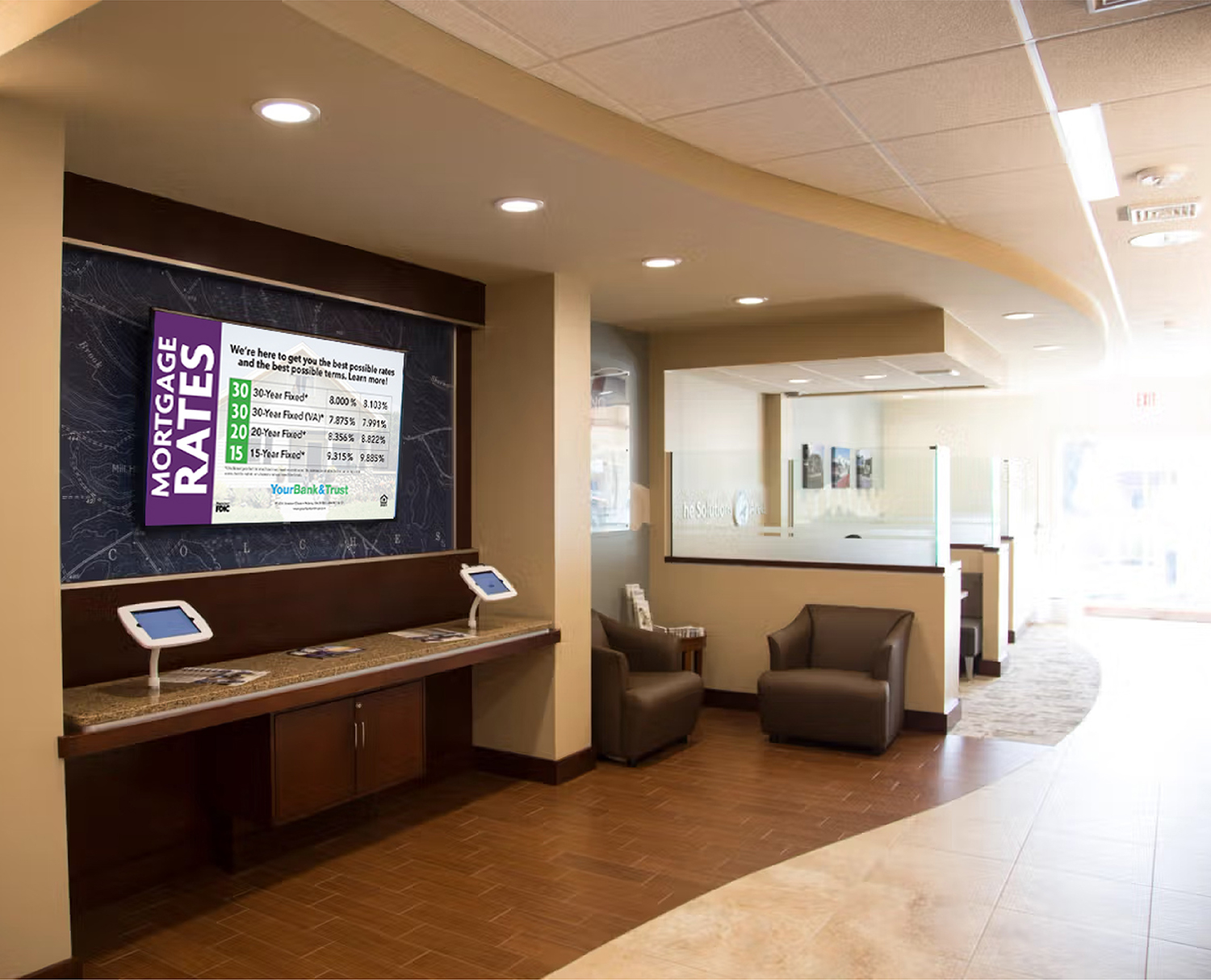
Over the past several years, financial institutions have invested heavily in digital transformation. They’ve optimized their mobile apps, refined their online experiences, and expanded their self-service capabilities. And, they’ve managed to do so with some success. In the process of this transformation, however, many have overlooked one of the most measurable and manageable, high-impact, and perhaps obvious engagement channels available to them: their physical branch.
Need to know
- Financial institutions have prioritized digital transformation but often overlooked the high-impact opportunity within their physical branches.
- Simply placing messaging in front of customers does not guarantee engagement.
- Many banks struggle with in-branch marketing; signage placement is poor and messaging is overly complex.
- Despite predictions of decline, the retail branch remains a key customer touchpoint that requires a behavior-driven communication strategy.
- Digital signage can leverage the branch experience with dynamic, targeted content. This enhances engagement, strengthens the brand, and drives growth.
Why We Buy and why it’s meaningful to bank marketers.
Paco Underhill is a retail expert and anthropologist, the founder of Envirosell, and the author of Why We Buy: The Science of Shopping. He has been studying how consumers interact with physical spaces for decades and the subjects of his study have ranged from high-end health and beauty retailers and fast food restaurants, to grocery stores and national banks. What he teaches, in a nutshell, is that proximity does not equal engagement. That is, simply placing your messaging in front of a customer does not mean it will be seen, processed, or acted upon.
The following, taken from his book, recounts Underhill’s experience with bank clients and how they struggle with in-branch marketing:
“Banks expend a lot of energy trying to figure out which signs work and which don't. Banks, fast-food restaurants and the post office have this in common: lots of customers standing still and facing the same direction; ideal opportunities for communication. The difference is that banks are some of the worst offenders in the art and science of sign placement. I can take you to branches of the world's biggest and most sophisticated financial institutions where placement of merchandising and informational materials is laughably inept.
There are church bake sales and kiddie lemonade stands that exhibit better signage sense than some banks I can name. Five minutes from my office is a retail bank branch where you can find this merchandising innovation: a cheap card table covered by the cheapest blue plastic tablecloth you've ever seen, atop which someone tossed some brochures for car loans and mortgages, joined by a TV monitor, once intended perhaps for showing in-branch videos but now unused and completely covered by a blanket of dust. The table is jammed into a corner in the front of the bank, just a few feet from the customer service desk. It's so bad that it's funny.”
Rethinking the role of the branch.
Despite predictions of its decline, the bank branch remains a critical touchpoint for customers. In fact, studies show that over half (52%–53%) of U.S. consumers are visiting a branch up to 4 times a year. But these consumers are not the consumers of the early 21st Century. Their expectation of provider engagement no longer includes leafing through a tri-fold brochure while waiting in line for 15 minutes. Today’s in-branch experience has evolved (or at least needs to evolve), and this evolution demands a more informed, insightful, and intentional approach to engaging in-branch individuals. A few things to consider:
- Timing matters: Messaging should appear when customers are most receptive; not when they are task-focused.
- Placement matters: Visibility is not enough; positioning must align with natural movement patterns.
- Simplicity matters: Messages must be immediately digestible, especially in high-distraction environments.
Digital Signage. From transaction to interaction.
Customers do not enter a branch to browse. They enter focused, with a purpose and chances are, their patience level is not particularly high. An effective in-branch marketing strategy must take this into account. Forward-thinking community banks recognize that the branch is not just a place to complete transactions; it is a place where perceptions can be shaped, relationships strengthened, and with any luck, incremental products and services sold.
Traditional in-branch marketing tools, such as printed brochures, static signage, and physical displays, are inherently limited. They are difficult to update, costly to maintain, and often disconnected from real-time priorities. Digital signage addresses these limitations while aligning more closely with modern consumer expectations. It enables institutions to:
- Deliver targeted, timely messaging that reflects current campaigns and priorities
- Adapt content dynamically based on time of day, seasonality, or customer flow
- Reduce a customer’s perceived wait time
- Reinforce brand consistency across locations
- Reduce reliance on printed materials and manual updates
More importantly, it transforms the branch from a transaction place into an interaction place.
A final thought.
Digital signage in banking has emerged as a transformative solution to the problems that Underhill points to, delivering the dynamic, real-time communication that can enhance a customer’s in-branch experience, reduce costs, reinforce the brand and, ideally, generate sales. The institutions that embrace this principle will not only improve the effectiveness of their in-branch marketing; they will redefine the role of the branch itself. And in doing so, they will turn an often-overlooked environment into one of their most powerful assets.
Bank Marketing Center
We’re Bank Marketing Center, the leading subscription-based, automated marketing platform designed especially for community banks. Our mission is to assist bank marketers in crafting, managing, sharing, monitoring, and distributing topical, compelling marketing communication that builds their brand and grows revenue. We do this by automating the essential marketing functions bank marketers rely upon; content creation, social media scheduling and monitoring, digital asset management, compliance routing, and more. This includes, of course, digital signage, which our partner banks are leveraging to transform their branches “from a transaction place into an interaction place.”
By working with our 300+ partner banks, along with having spent collective decades in financial services marketing, we know what works and what doesn’t. We know what community bankers need. We monitor industry trends, share what we know, and are continually adding new features to our platform to help our partner banks succeed.
Want to learn more about what we do for bank marketers to help them succeed? You can start by visiting bankmarketingcenter.com. Then, feel free to contact me directly by phone at 678-528-6688 or via email at nreynolds@bankmarketingcenter.com. As always, I welcome your thoughts.